


Heading 6
Dec 2025
By:
Patricia Spencer
Finding Africa in North Texas
A few weeks ago, I participated in a Zoom meeting hosted by creative writing professor Daniel Chacón from the University of Texas at El Paso. He invited writers, publishers, and professors to share their experiences and expertise in publishing and podcasting. The bright spark that energized me as a writer was the presentation by Jessica Powers who spoke about her passion for African literature and how Catalyst Press presents an annual #ReadingAfrica week, which celebrates African literature. I knew I wanted to volunteer as an intern for Catalyst Press, not only because I am a writer but also because of a life-changing experience I had working as an English as a Second Language (ESL) intern at *Refugee Services of Texas (RST) in 2019 and 2020 in Fort Worth, Texas. This experience at RST was very profound, and though years have gone by, I still keep a strong bond with my first refugee family from the Democratic Republic of the Congo (DRC).
This connection all started in 2019 when I was in the process of giving away 200 books as I was trying to move from Denton back to my hometown of El Paso, Texas. I contacted RST in nearby Fort Worth hoping they would accept my books as a donation. The agency’s resettlement assistant Myrah answered the phone on the second ring. She was extremely receptive to accepting all my American literature books, cookbooks, science, math, geography, and American and world history books. That is when my journey into understanding the lives of African refugee families from the DRC began.
After my conversation with Myrah, I loaded up the books and drove to RST in Fort Worth. When I arrived I was given an introduction into the agency’s operations and their resettlement process for refugee families from Africa through the United Nations High Commissioner for Refugees. After I learned about this process, I was convinced that I wanted to work as a volunteer and intern, which involved welcoming the families and helping them settle into American life in North Texas. So, I decided to stay in Denton and hold off on moving back to El Paso.

I was so humbled and profoundly inspired by the new families’ desire to acclimate themselves to their new lives in Texas, and I compiled a list of questions for the first new family I was going to assist. The family had lived in refugee camps in the DRC and Rwanda for most of their lives. Pascual was a single father in his forties and was raising two teenagers and two young adults. Their arrival in the USA was both exciting and daunting for them. They spoke a combination of Lingala, French, and very little English. The things they considered most important in beginning their new lives in America were freedom, finding a job, law and order, access to public education and adequate health care, and safety and protection from the rebel soldiers and corrupt police in their homeland.
ESL classes for the refugees took place every day in a small recreation center at an apartment complex that collaborated with RST to offer housing, space for learning, recreation, cultural events, food, and clothing distribution. The ESL curriculum was very basic and could be ranked at a second to fourth grade level with material emphasizing foundational grammar and building vocabulary though common activities such as household chores, cooking, shopping for food and clothes, recognizing health problems, using electronic media, and establishing social contacts with new friends and neighbors.

When I met my DRC family for the first time, the first words out of my mouth were, “Welcome to America. We are glad you are here!” It was an emotional moment that placed me in a welcoming position to exemplify everything good about the USA. At the host apartment complex in Fort Worth, I was especially struck by the African women refugees’ implementations in adjusting to apartment complex living. They placed large baskets of laundry on their heads and walked confidently to the laundry room while chatting with their neighbors. They hung their colorful clothing out to dry on makeshift clotheslines and trees. What caught my attention were the bountiful gardens with flowers, vegetables, and herbs growing in small patches of available soil around the apartment complex. Many families had already taken the initiative to network with others in order to better acclimate to their new homes and enhance their English language skills. A smile went a long way. It was a universal sign of acceptance, accomplishment, and joy.

Being Latina and from the Borderland of El Paso, I wanted to share a Latin American Christmas custom with my new family by celebrating the Day of the Epiphany, which fell on January 6, in 2020. I purchased a Rosca which is a festive, ring-shaped bread, topped with dried fruit and nuts. Each Rosca has a tiny plastic infant representing Jesus baked inside it. The person who finds the infant is considered Jesus’ godparent and must host a gathering on the second day in February and serve tamales and a traditional Mexican corn-based drink called atole. I strove to introduce and celebrate national and religious holidays with my DRC family, but I also embraced their African culture. For example, on World Refugee Day which is a yearly event in June when we all came together to celebrate our families’ accomplishments, I was introduced to savory rice dishes with raisin, nuts and herbs. They were placed next to our coleslaw and chocolate brownies.
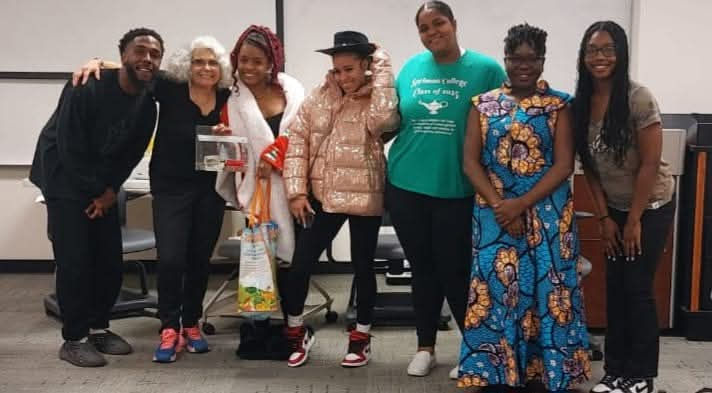
After my internship and doing volunteer work for over two years, I aspired to write plays about my experiences at RST. I applied to Texas Woman’s University Theatre master’s program in 2023 to pursue playwriting and theatre. I wrote a play for Professor Esther O. Ajayi-Lowo and her Women’s Studies’ undergraduate classes at Spelman College. My play Looking for a Beautiful Life attempts to portray the experiences of African Congolese refugee women trying to embrace the American dream in Fort Worth, Texas. The play was adapted from Rodgers and Hammerstein’s musical, Oklahoma! Student volunteers with no acting experience performed in the play. I was the director. The students connected to the song “Oh, What a Beautiful Mornin’” and the main character in my play, an African female refugee named Spear who has just auditioned for the character Laurey in Oklahoma! Spear uses the lyrics from “Oh, What a Beautiful Mornin’” to make a statement to everyone that she has acclimated herself to life in America and is becoming confident in building her new life in Fort Worth.
This learning outcome fueled my creative writing aspirations, specifically to adapt my creative fiction, nonfiction, flash fiction, science fiction, and political satire to plays that can be presented to a wide audience in schools, non-profit organizations, and any place where stories and plays can touch an audience anywhere in the world.

I continue to visit my special family to this day. Today, Pascual is a naturalized American citizen, is remarried, and has a new baby boy.
Currently, I still live in Denton, Texas, and I am a second year Creative Writing Online MFA student at the University of Texas at El Paso. I received my MA in Journalism from the University of North Texas in 2009. My hope is that this story inspires you to celebrate #ReadingAfrica week, to embrace African literature, and to learn more about Africa and its people and their passion for reading and writing literature.
*Due to budget shortfalls, Refugee Services of Texas closed after 45 years in May 2023.